Does this art pass the Howey test?
A perpetual resale covenant, enforced through authentication instead of litigation.
The story
In 1946 the Supreme Court decided SEC v. W.J. Howey Co. and gave American law its definition of an investment contract: an investment of money, in a common enterprise, with a reasonable expectation of profits, to be derived from the efforts of others. Every crypto whitepaper of the last decade was written in its shadow. The Church of Conceptual Art, a religious nonprofit founded by artists and incorporated in Montana, now issues artworks that invite the question on purpose.
Every work CoCA issues is bound by a perpetual resale covenant. The seller keeps everything up to an edition-specific threshold, $30,000 for the Genesis Artifact and $14,000 for Radical Genealogy, and fifty per cent of anything above it remits to the artists, on every future sale, in perpetuity. The covenant requires a documented chain of custody for every transfer, and custodianship is recorded permanently in the CoCA institutional register.
The interesting part is enforcement. Artist resale royalties have existed on paper for a century, France wrote the droit de suite into law in 1920, and they have never really worked, because suing a collector costs more than the royalty is worth. The CoCA covenant enforces through authentication instead. A resale that does not remit voids that work's certificate. The void is recorded in the register. And without a live certificate the work can no longer be represented as part of the edition, which is where its value sits. No lawsuit, no damages, no discovery: the institution simply stops saying yes.
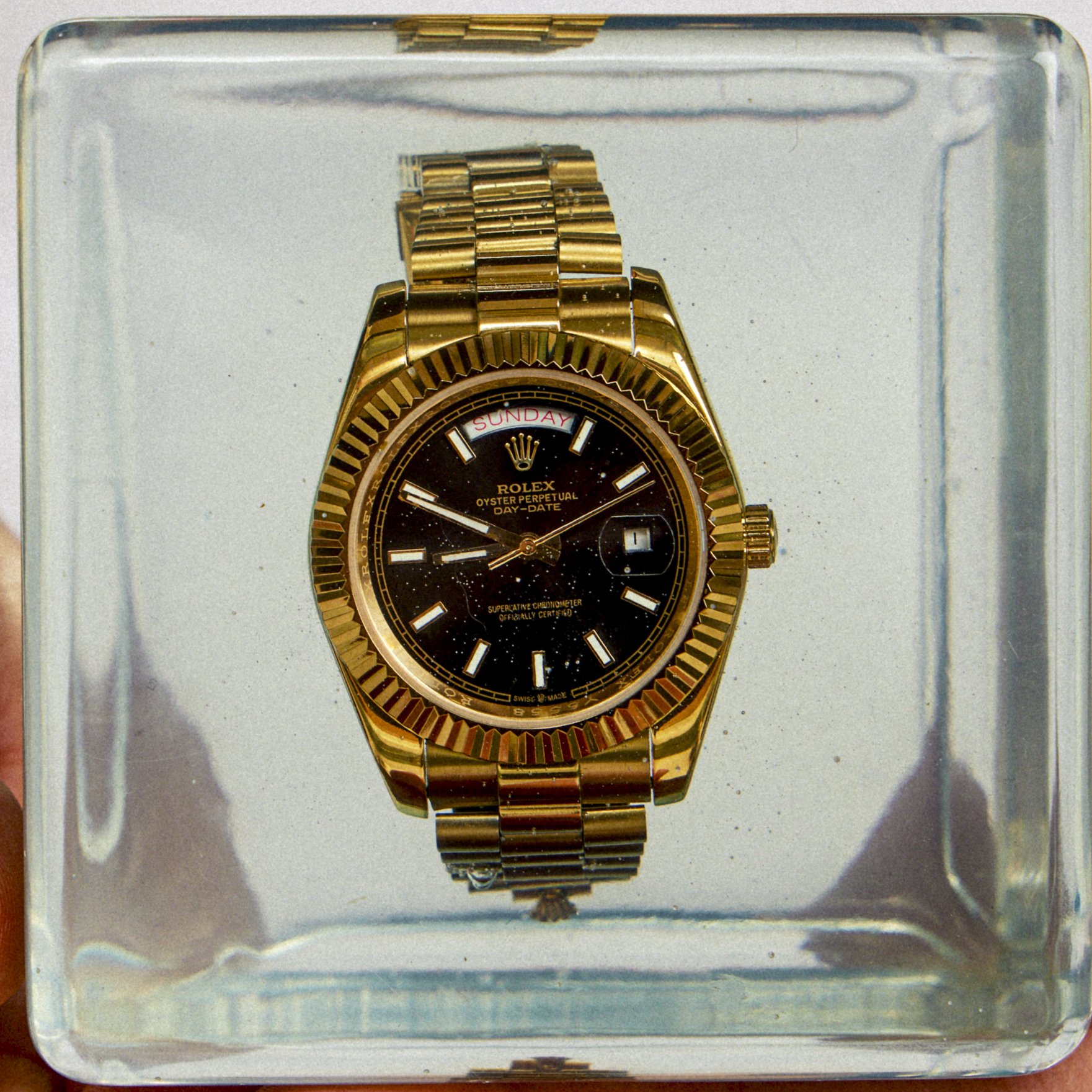
The objects under covenant are deliberately strange. The inaugural work, Genesis Artifact (2025–2026), is an edition of ten unlicensed Rolex Day-Date 40 wristwatches sealed permanently in archival resin and impressed with the CoCA institutional seal: unwearable, unopenable, $15,000 each. Pissarro's gloss: "the resin is the blockchain, the covenant is the smart contract, and the lineage is the whitepaper." Under the same covenant, Radical Genealogy (RAD-GEN.001, 2026) is one hundred oil paintings in the late style of Camille Pissarro, generated as studies and painted by hand, in oil, by Kim Van Do, $7,000 each.
So, the test. An investment of money: yes. A common enterprise: one register, one covenant, every edition. An expectation of profits: the covenant does not merely anticipate resale above the threshold, it budgets for it. Derived from the efforts of others: the artists keep working, and the price moves. Four for four, read one way. Read the other way, the instrument runs backwards: CoCA promises the buyer nothing. No returns, no buyback, no roadmap. The only party holding a contractual expectation of profit from someone else's efforts is the artist, who collects when the collector sells well. If there is a security here, the collector issued it.
No court has been asked. The covenant's first real test will arrive the way these things always arrive, with a resale. Until then the question sits in the title, where conceptual art has always kept its sharpest tools.
Paul-Alexander Pissarro is a conceptual artist in London, the great-great-grandson of Camille Pissarro and the sixth generation of working Pissarro artists and scholars. Works under covenant are placed through Name of My Gallery.
Fast facts
- The CoCA resale covenant: fifty per cent of any resale value above an edition-specific threshold remits to the artists, on every transaction, in perpetuity
- Thresholds: $30,000 (Genesis Artifact), $14,000 (Radical Genealogy)
- Enforcement through authentication: a resale that does not remit voids the work's certificate, and the void is recorded in the CoCA institutional register
- Every transfer requires a documented chain of custody; custodianship is recorded permanently in the register
- Genesis Artifact (2025–2026): edition of ten unlicensed Rolex Day-Date 40 wristwatches sealed in archival resin, unwearable and unopenable; $15,000 each
- Radical Genealogy (RAD-GEN.001, 2026): edition of one hundred oil paintings in the late style of Camille Pissarro, painted by hand by Kim Van Do; $7,000 each
- Issued by the Church of Conceptual Art, incorporated in Montana as a religious nonprofit
- The Howey test: SEC v. W.J. Howey Co., 328 U.S. 293 (1946)
Images
Links
- paulpissarro.com/portfolio, the works
- churchofconceptualart.org, the institution
- rad-gen001.unsubscribe.llc, the Radical Genealogy ledger, canvas by canvas
- Name of My Gallery, acquisitions
Contact
Paul-Alexander Pissarro, London. Interviews, high-resolution images and further material: paul@paulpissarro.com